The Ordinary Miracle
Every sentence turns private thought into sound, gesture, or inscription. The familiar act of speaking is also an astonishing coordination of mind, body, and interpretation.
Forthcoming 2026 · Dan Herbatschek
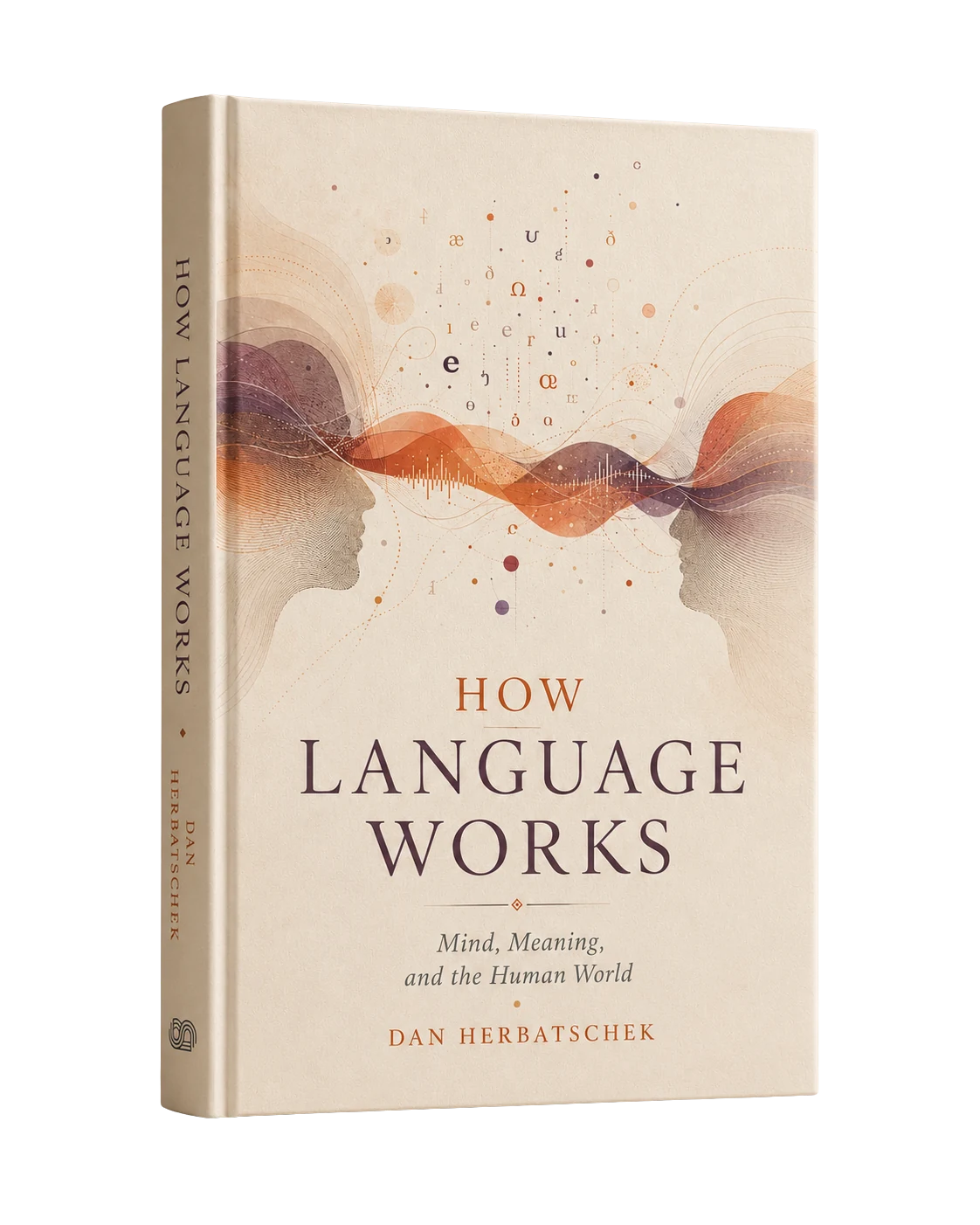
Mind, Meaning, and the Human World
A sweeping inquiry into the ordinary miracle of speech: how breath becomes sound, sound becomes meaning, and meaning becomes the shared world human beings inhabit.

We speak, and meaning appears. We listen, and another mind becomes partly available to us. We read marks on a page, and the dead speak. How Language Works treats that everyday act not as background, but as the central drama of human life.
From speech sounds and symbols to grammar, memory, institutions, identity, and culture, the book asks how language gives shape to thought and makes shared reality possible.
Language is not merely communication. It is the architecture through which minds meet, memories survive, and culture becomes cumulative.
Every sentence turns private thought into sound, gesture, or inscription. The familiar act of speaking is also an astonishing coordination of mind, body, and interpretation.
Human language can speak of what is absent: the dead, tomorrow, justice, home, possibility, God, nothingness. It frees the mind from the prison of the immediate.
Words do not need to resemble what they mean. Because symbols are conventional, they can represent visible things, invisible things, and worlds that do not yet exist.
From finite sounds, words, and grammatical patterns, human beings generate sentences never spoken before. Language is creativity built into cognition.
Language lets knowledge outlive the person who discovered it. It turns memory into inheritance and intelligence into a cumulative human project.
Laws, promises, names, borders, vows, histories, and identities are held together by shared symbols. Language describes reality, but it also helps constitute it.
A mind reaches outward. A body turns thought into sound. Another mind receives it. Meaning crosses the dark.Read the book overview
KEY THEMES
The book moves across linguistics, philosophy, cognitive science, history, culture, and the inner life — always returning to the mystery of meaning.
How language clarifies thought and lets ideas become shareable.
MeaningHow symbols, differences, and use allow words to carry worlds.
CultureHow knowledge survives across generations and becomes civilization.
PowerHow words frame reality, authorize institutions, and shape perception.
SelfHow stories, names, and emotional vocabulary shape identity.
FREQUENTLY ASKED QUESTIONS
It is intellectually serious, but written for general readers. Technical ideas appear only where they illuminate the larger story of mind, meaning, and human culture.
No. The central claim is that language is more than communication: it is a shaping force for thought, memory, identity, institutions, and civilization.